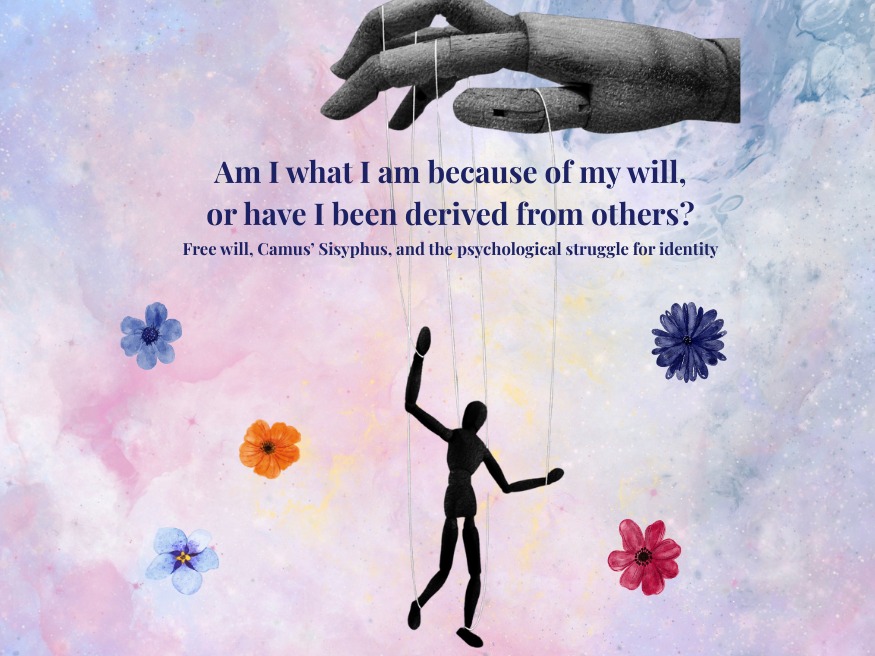
Am I what I am because of my will, or have I been derived from others?
 December 17, 2025
 Introduction
Whenever questions of identity are brought up in therapy, they look a lot like “I don’t even know what I want” or “I think I have just become this way because of people around me” or even “I don’t think any of my thoughts are original”. Beneath these questions lies a more unsettling thought of whether the self exists through free will or is formed through the perception, demands, and histories of others.
Camus’ Sisyphus and Self
The tension of authenticity, agency and free will is the core of the myth of Sisyphus. Camus begins with the problem of the absurd: the collision between the human longing for meaning and a world that offers none inherently. Sisyphus, pushing a boulder up a mountain only to watch it roll back down, becomes this condition. His fate is imposed and freedom appears minimal.
From a psychological standpoint, this seems like a central truth about identity formation. None of us begins as a blank slate. We are born into families, cultures, languages, genders, class positions, and histories that precede choice. Much of what shapes us is not willed but inherited, or imposed by families or society. The absurd emerges when we recognise this and have the ability to ask, “Who am I, really?”
Free Will and Identity in Psychology
Viktor Frankl, Rollo May and Irvin Yalom reject the idea of complete free will and instead look at the capacity to choose one’s stance, meaning, and response within real constraints.
In a sense, Sisyphus cannot escape the task but can choose his relationship with the boulder task. Being in conscious awareness of his task is a step towards redefining his identity and making a choice. We may not choose our conditioning, but we can choose how consciously we engage with it. This distinction is helpful when clients sit with questions like:
Am I living my life or following a script provided by family or society?
Are my desires authentic, or have they been borrowed? and are my desires only limited to what is permitted?
To live authentically is not to deny that others shape us, but to acknowledge this shaping without giving up responsibility for our present choices. Sartre called this the avoidance of bad faith, while Camus says that Sisyphus does not pretend he is free of his condition, nor does he collapse into despair. His authenticity lies in refusing the illusion of false hope or helplessness.
Many clients experience distress not because they lack an identity; in fact, everyone is uniquely themselves without even recognising it. However, they believe their identity should feel resolved and constant. Existential psychology normalises the idea that identity is ever-changing, affected by time, and often forged in tension or through significant life events.
Camus’s Sisyphus holds significance not by reaching the summit but by returning to the task with awareness. Similarly, identity is not proven by certainty but sustained through repeated, conscious engagement with one’s choices.
So then, what is the answer?
The answer is both, things have shaped us, and we choose how to respond to them. You are shaped, undeniably, by forces beyond your choosing. But within those contours lies the space of will: the capacity to reflect, to resist, to reinterpret, and to commit. Free will, in this sense, is not about control over the origins of behaviours or thoughts but responsibility for meaning.
Camus’ philosophy or even existential psychology does not offer comfort in the form of answers. They offer dignity in the act of questioning itself and allowing space to explore and choose for oneself. To ask “Am I living as myself?” is already a form of rebellion against unconscious existence.
December 17, 2025